
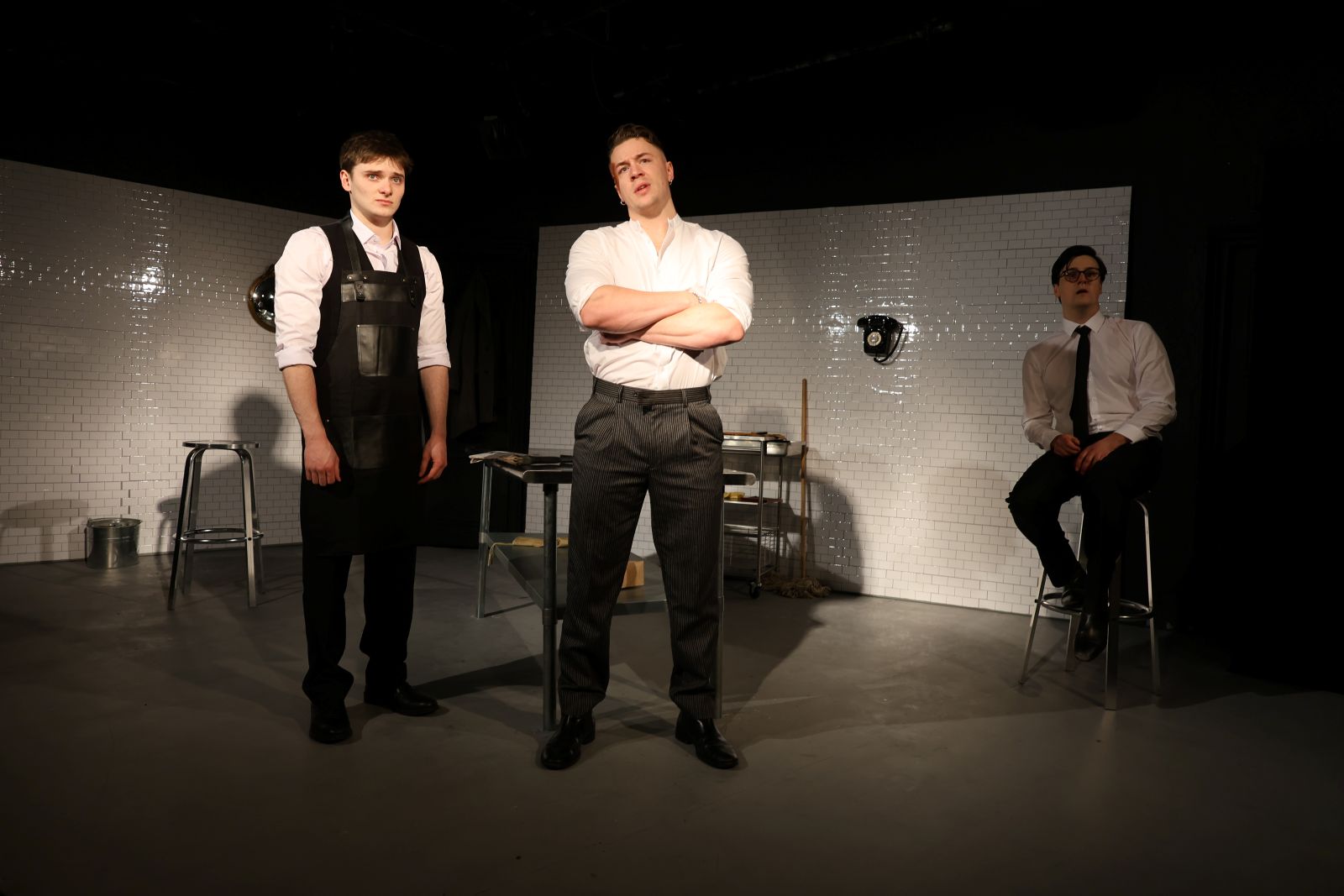
Performer and writer Edmund Morris tells The Theatre Playbook abouts bringing his stage play The Grim to Southwark Playhouse Borough, creating this story of two undertakers in 1960s London and why it’s a show that demands repeat visits.
The Grim has played at the Edinburgh Festival Fringe and London’s legendary Old Red Lion Theatre. Now Edmund Morris’s darkly comic The Grim comes to Southwark Playhouse this winter.
A spine-tingling comedy set in 1964 that delves into the bizarre world of dead bodies – and the supernatural – it takes place as Shaun is trying to get through another dull day as the proprietor of his family’s undertakers alongside his hopeless and superstitious assistant Robert.
On the night they are due to fit the notorious Jackie Gallager for his coffin, this farce follows their journey as they hold out against the horrifying reanimated corpse of Britain’s most violent criminal.
Morris also stars as Shaun, with Louis Davison as Robert and Harry Carter as Jack. It is directed by Ben Woodhall and produced by RBM.
Here, Morris tells The Theatre Playbook about the origins of The Grim, the numerous genres touched by the play and expanding the show from its previous form at the Edinburgh Fringe.

Hi Edmund, please introduce us to The Grim.
The Grim is what I would call a ghostly, comic-thriller set in the murky streets of 1960s East London. The play centres on two undertakers, Shaun and Robert., who, on the day they’re due to fit infamous murderer Jackie Gallagher for his coffin, they begin to encounter some strange goings on. One thing leads to another, and essentially, the play evolves from a morbid episode of Only Fools & Horses, into an action-packed, horror-tinged episode of The Sweeney.
What are the origins of the project?
I get asked this a lot, and to be honest, I’m not really sure. What I do know is that one day, I thought of a funny conversation between two undertakers; how they deal with their grisly occupation and about all the different types of gallows humour that probably comes from a job like that. I then quite quickly established that one was English and one was Irish; my dad being a cockney and my grandad being a Dubliner almost definitely paving the way for me. I then thought, what would really ruin these two characters’ day? And thus, Jackie Gallagher was born. I won’t say too much about his role in the play, but suffice to say, things really kick up a notch when he arrives…
Who are the characters we meet and how do we follow them through the story?
First up is Shaun, a cynical cockney who’s recently inherited the family business. He’s grieving the loss of his father and is struggling to fill his shoes. He takes pride in his work but has trouble doing anything correctly. He loves sweets, he loves the pub, and he loves winding up Robert, his superstitious assistant.
Robert is very much the flip side of Shaun. He’s deeply religious, often turning up late to work for spending too much time at church, and has an amygdala roughly the same size as a mouse. That being said, he gives Shaun as good as he gets, and he’s intensely loyal to his de-facto best mate.
Now Jack is the furthest thing you could get from Shaun and Robert. He’s a traveler originally from the North of England; a hulking, warrior-like figure that lives, and dies(?) by his own laws. Born and raised in a brutal world, survival is his business, and violence is his currency, and he’ll do whatever it takes to do what he thinks is right. I’ll leave it there for now. The less said about him, the better.
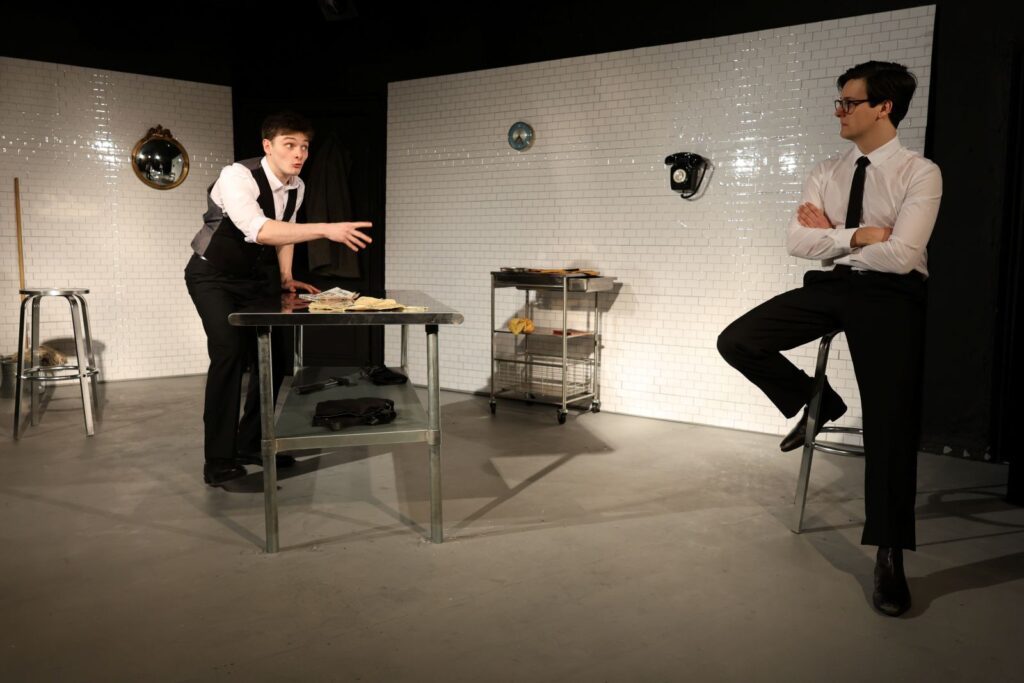
How have you sought to balance a range of genres, from comedy and horror to the supernatural?
One of the great things about comedy writing, and the reason why I think I lean into it so much in my work, is because it’s a great way of undercutting some very serious subject matter. If you build the comic elements of the show well-enough, you basically lead the audience down the garden path, and then rip their feet out from under them; that rise and fall in a script is what I’m always looking out for. The reason why I think the horror and supernatural elements work so well in this piece is because you effectively have one character that does believe in the supernatural, and one that doesn’t. We don’t beg the audience to suspend their belief and surrender to a world where all of this is possible, we present them with quite a logical debate between two people with diametrically opposing beliefs, so that when stuff does start to get a bit weird, the audience are experiencing it exactly the same time as the characters on stage.
How does its 1964 setting inform the story or characters?
Setting it in the early 60s was a very early choice of mine, and I did it for pretty much two reasons:
1. The 1960’s were cool.
2. It’s far enough away that it could pass as a ‘traditional’ ghost-story, but close enough for it not to feel like a period piece.
Has the show changed or evolved for its latest outing at Southwark Playhouse?
100%. The past two iterations the show has been a one-hour piece of fringe theatre. That was a decision made out of necessity, since you can’t haul a full-length play up to the Edinburgh Fringe Festival, at least, not unless you have loads of money, but that’s another conversation for another time. After we performed at the Old Red Lion back in January, we knew that the piece had sort of ‘outgrown’ itself. The story was bigger than the play we were producing, so as soon as that run finished, I set about expanding the play. We’ve now also had a serious bit of time to re-think the sound and lighting elements, so we’ve managed to up the ante in every aspect, which I’m really happy about.
Why do you think the show has had the “legs” for several different productions?
I suppose it’s because play touches on so many topics that a lot of people are fascinated with. Death, friendship, ghosts, folklore, crime, punishment, revenge… it’s all there. I truly think The Grim is a show that’s more than the sum of its parts, and the world we’ve created is one people want to revisit again and again, and I feel really privileged to have played a part in that.
What’s your writing process?
The majority of my writing process is whipping out my phone at almost any time of the day and writing down a funny idea or something interesting that I’ve seen or overheard. Then, it’s coffee, or a beer, my laptop, and letting the characters dictate where the story goes. All sounds a bit artsy and pretentious, but that’s how I write, I’m really sorry.
How do you work with director Ben Woodhall?
Terribly.
In all seriousness, Ben is one of the most fantastic directors I’ve ever worked with. Luckily I’d worked with him way back on a production of Romeo & Juliet so I had an understanding of his style and attitude towards working with actors. A few years and one pandemic later, I’d finished my first draft, sent it to him and the rest is history. I would go out on a limb and say that Ben is an actor’s director – he understands their mentality so well, and is so detailed in his approach, that you end up discovering something new every five seconds. As a writer he’s a real gift, as he will spot things in your writing that you perhaps hadn’t given much thought to, and that will then become a defining feature of your performance, or the play as a whole. The play wouldn’t be what it is without him. 10/10 would recommend.
Are there any challenges when it comes to putting on or performing in the show?
Yes… money. Putting on a play like ours is costly. We’ve done well so far, having ran a few fundraisers in the past and luckily secured one or two backers after the Fringe festival, but this time it’s bigger, it’s better, and we need to raise a fair bit of cash to get it over the line. Paying actors, paying crew, print, marketing – it all adds up and we would welcome any donation no matter how big or how small. We have a Kickstarter campaign up and running and will be hosting some small events in the coming weeks to help raise money, so keep your eyes peeled. If you enjoy going to see original theatre, and supporting those in the early throws of their career, then please consider donating, it would mean the world to us.
What can audiences look forward to seeing with The Grim?
Lots of laughs, lots of jump-scares, lots of violence and lots of blood. This is a hilarious, horrifying and high-octane thrill-ride, so strap in and get ready for one of the most entertaining nights of the year. We’ll see you there.
The Grim plays Southwark Playhouse Borough from Wednesday, November 26 – Saturday, December 6, 2025. Tickets here.
Top image: The Grim, photo by Molly Jackson-French (image supplied)