
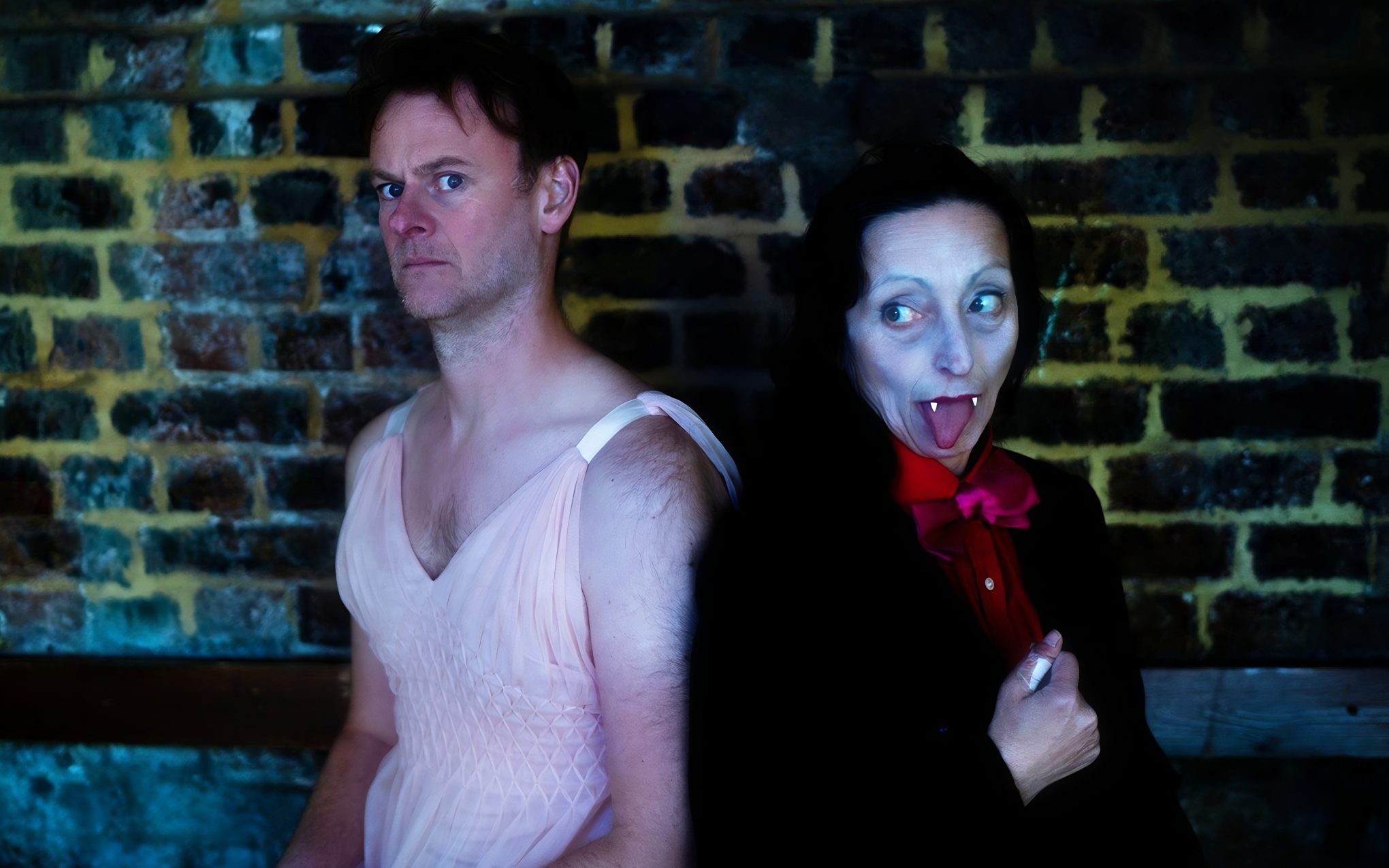
Ahead of the debut of Countess Dracula at Camden People’s Theatre, star Joanna Holden tells The Theatre Playbook how the show explores the impact of the menopause through a radical reimagining of Bram Stoker’s Dracula.
It’s a radical reinterpretation of Bram Stoker’s Dracula that will have its premiere at Camden People’s Theatre this week.
Performed by Joanna Holden (Told by an Idiot) and Jack Kelly (Shrimshanks), Countess Dracula unfolds as a strange vaudeville double act where the performance never quite ends – and real life never quite begins.
Part horror, part satire, part love story and part breakdown, it uses The Countess (Holden) as a theatrical frame through which to explore the lived experience of the menopause. At its heart is a woman reckoning with this often unspoken stage of life – confronting its rage, sadness, madness, and humour – while playfully interrogating society’s treatment of ageing women.
Here, Holden tells The Theatre Playbook about conceiving the idea behind the play, the themes it confronts, taking on Bram Stoker and getting into character.
Hi Joanna, please introduce us to the production of Countess Dracula.
The show begins in Bridlington – an end-of-pier Countess Dracula show played by two vaudevillians: a woman who is also experiencing the menopause and her double-act partner. It tells the tale of the breakdown of their act and the strain on their relationship, and how she begins to find her power, transformation, and subsequent revenge on the world by harnessing the powers of Dracula.
Who is the Countess, and how do we follow her through the show?
The Countess in our show is a fictional countess who plays the part in an end-of-pier show and is struggling to function in the world. She slowly begins to transform into Countess Dracula in her real life, and we witness her harness the powers of Dracula to wreak havoc on a world that doesn’t understand her. Through this, she finds a new way to exist in the world.
It is described as a radical interpretation of Bram Stoker’s classic story. What can you tell us about how the story has been adapted?
We have taken elements of Bram Stoker’s Dracula – namely the character himself – and explored these characteristics alongside the experience of being a woman going through the menopause: the not wanting to look in a mirror, the night madness, the yearning for eternal youth, the horror, and the unexplainable rage. We’ve taken these elements and created Countess Dracula. How does this possession allow a menopausal woman to express herself, and how does she behave in the world with this power? What are the consequences? It is a very loose adaptation!
What are the origins of the production?
One day I was slumped on the Underground, holding up my chins, contemplating my tiredness and lack of libido and wondering who this person was that I didn’t quite relate to. The thought of sucking young men’s blood for their testosterone came into my mind – weird as it may sound – and I started to contemplate the idea of a female Dracula allowing her rage, her appetite, her need to survive to be let loose on the world. I started to read the novel and spoke to other menopausal women who seemed to relate to this comparison, and so began to explore the role of Countess Dracula through the gaze of a menopausal woman! I spoke to my friend and fellow performer Jack about it, and he said: “Let’s do it!”
How were you involved in the development of the show?
I guess I brought the experience of menopause and my struggle with it to the table, and Jack brought his brilliant experience as a theatre maker and producer. Together we explored the parallels with Bram Stoker’s Dracula. We did some initial research and development with John Wright, who was brilliant, and other performers, and we also ran workshops with menopausal women. We began devising – and are still devising – the show with our brilliant director, Debs Newbold.
How have stories of experiences with the menopause influenced or inspired the show?
The experience of the menopause, and the horror that can be for some women, has been the starting point of the show. The desire to share that experience in a hopefully entertaining and informative way has also influenced the process. When I spoke to women about a menopausal Dracula, they really related to that sense of, “Am I an unpredictable monster? Am I wild? Am I mad? Am I a creature of the night, a shape-shifter?” – and this led us to Countess Dracula.
What are the themes you want to discuss through the show?
There are so many themes: change, transformation, disappearing and fear of who you have become, mental health, societal pressures to stay young and sexual to be relevant, and what it means to emerge from the dark side. The loss and regaining of power, to name a few. We are still making the show in many ways, and there is so much to explore.
How does it also blend horror, satire and a love story with a breakdown?
The love story is a couple who work together, and one of them (me) is going through this experience that affects every aspect of their lives, while the other is trying to hold that person. The horror is the menopause experience, and the humour arises when I embrace the power of Dracula and allow that to empower me to exist in the world! I hope that makes sense!
What can you tell us about your performance, and how do you get into character?
In this show, the character is me, and I have a story to tell. I try to embrace the pleasure and playfulness of being present, connecting with the audience, and sharing that story. As the show is very new, I must be open to the fact that we will be continuing the process of exploring as we play. To do this, I have to accept I may have brain fog, I may forget, and my note to myself is to sit in the truth and keep flexible. A herbal tea before we begin always helps – as well as the Dracula costume!
How have you prepped for the show alongside Jack Kelly?
Jack and I are telling the story together – it isn’t just my story, it’s our story – and we have shared, played, suggested, and provoked each other.
How are you working alongside director Deborah Newbold?
Debs is a wonder and a very talented performer and storyteller, alongside being a director. All of her experience, playfulness, and wisdom have been invaluable. She has been responsible for provoking us too and trying to place and honour a myriad of ideas into a performance. I’m in admiration of them both.
What are your hopes for the show?
That it will continue to develop and form, as this is its very first sharing, and I feel the work is never done. That audiences will enjoy it and, at the same time, will also be provoked.
What are you working on next?
I’ve been performing in Pride & Prejudice and making this show in the day, so I’ll be working on sitting still for a while and regrouping with my dog!
Countess Dracula will run at Camden People’s Theatre from October 29 – November 1, 2025. Tickets here.
Top image: Countess Dracula, Jack Kelly & Joanna Holden, Photographer Henry Maynard (image supplied)