
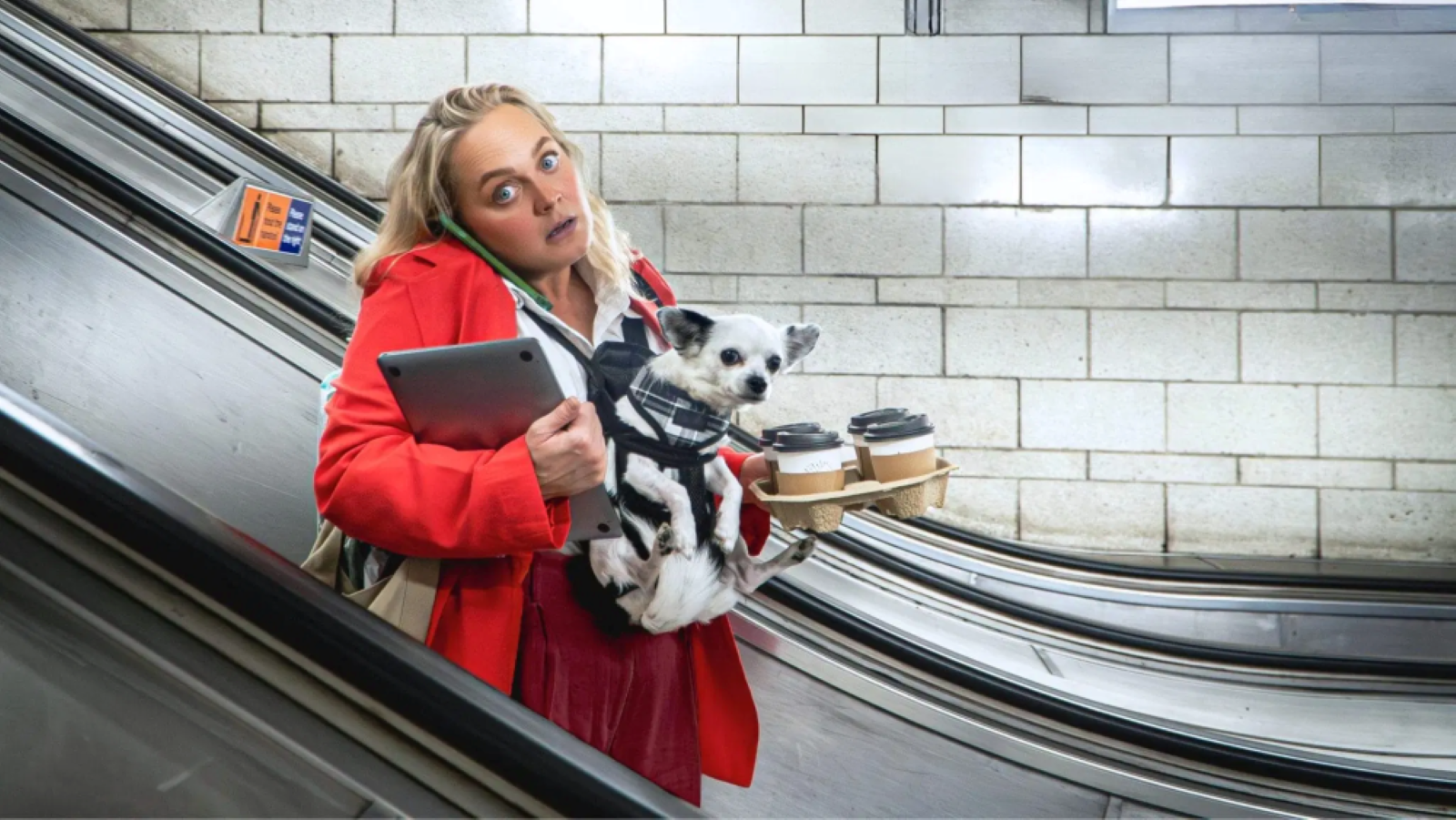
Inspired by her own real-life experiences working multiple jobs, actor and writer Libby Rodliffe brings her timely and topical financial dark comedy Jobsworth to London’s Park Theatre this winter.
It tells the story of Bea, a millennial caught in a financial trap who has been forced to work simultaneously as a personal assistant, data inputter, overseer of luxury flats and dog sitter. Over-worked and under-paid, the show explores the hilarity of her situation and the moving circumstances which led her to acquire the debt she is paying off.
The show sees Rodliffe take on more than 10 roles, including Bea’s bolshy
cokehead boss, the super-nice super-fit temp, and her parents: her melancholic dad and highly
strung mum.
Transferring to the capital after its debut at the Edinburgh Fringe in 2024, it is written and performed by Rodliffe, co-written with Isley Lynn and directed by Nicky Allpress.
The creative team also includes sound designer Matteo Depares, set designer Matthew Cassar and lighting designer Han Sayles.
Here, Rodliffe tells The Theatre Playbook about writing Jobsworth with Lynn, performing numerous roles on stage and how her own experienced influenced the show.
Please introduce us to Jobsworth
Jobsworth (co-written with Isley Lynn) is a farcical workplace comedy about a young woman called Bea, who’s secretly working three full-time jobs. None of her bosses know about each other and she needs to keep it that way because the only reason she’s juggling all this is to try and keep on top of the substantial amount of debt she’s suddenly found herself in. When Bea discovers one of her smarmy boss’ dirty secrets while working somewhere she shouldn’t be, it’s only the threat of mutual destruction stopping the plates she’s expertly spinning from crashing down around her.
What can you tell us about Bea, and how do we follow her through the show?
Bea’s the underdog we all want to see succeeding in work, life and love. She’s the embodiment of skilled, conscientious and valuable employees who are often overlooked, taken for granted and exploited. She’s an example of how far we stretch ourselves at work and at home, and also an example of how financial ruin is only one bad choice away. Bea’s witty, quick and cunning, but also has a big heart. She fancies her co-worker, and she misses her friends and she has weird parents. And she can never seem to catch a break. Really, she’s just trying her best.
What are the origins of Jobsworth?
After I graduated from drama school I was looking for something that I could earn a full-time wage from when I wasn’t acting. Temping seemed to be a great fit and it’s kept me afloat for the last 10 years. I’ve had some wonderful jobs, and met some great people, but I’ve had a lot of pretty dreadful jobs too. I used to send Isley weekly voice notes about that recent week’s temping travesties – some of the stories were so ridiculous that Isley suggested we write a play. Once we got to planning it, there was so much material that it sort of started to write itself.
How did you draw on your own experiences for the show?
As well as calling Isley to cry/scream/laugh (less frequent) about my temping horrors, I used to call my mum. After a few months (when she couldn’t bear to hear me complaining any longer), she suggested I start redirecting my work-related grievances to a greater cause – something she now fondly calls my Little Black Book. If my day was awful or funny or unusual, it went in there. Working five days a week in various London offices meant there was always plenty of experiences to draw from.
Where did you find the show’s dark humour in the cost-of-living crisis?
It’s all so effing ridiculous that it’s sort of darkly humorous already isn’t it. I bought a sandwich from a deli on my lunch break today and it was NINE BRITISH POUNDS. That’s just over half the London Living hourly wage. And lunch breaks aren’t paid. But honestly I think if you’re going to do a show about our bleak economy it has to be funny. Because can you imagine the vibe in the bar afterwards?
How did you write the show with Isley Lynn?
After approximately 10279437298236 voice notes, we started talking seriously about what this show could look like – What did we want to say? Who would be in it? What are the big ‘Oh, shit’ moments and how do we get there?
Once we had a pretty solid idea of the shape of it, we pitched-up-shop in Isley’s attic (sounds grim but is in fact glorious), hit record on a phone, and I improvised for hours around the sections we’d discussed. Isley would then type it all up, and we’d edit it into a script from there. I trained in improv after drama school and can honestly say this process was such a dream – improvising the play as we wrote it – in an attic! It was so much fun.
How did you consider how the show would be performed as you wrote it?
We knew the story was all coming from Bea’s perspective, and that Bea would be the protagonist driving the show forwards, keeping things clear and QUICK (this is a very fast-paced show). And we knew pretty confidently what the other characters sounded and looked like, and how they stood and moved, because this all came from the improv process.
In terms of staging and set though, we had no idea. And by the end of the writing process, we desperately needed a fresh perspective to help with finding the nuances and idiosyncrasies in the characters.
(Thankfully our brilliant director, Nicky Allpress, came with visions aplenty).
You play 10 roles – how did you approach creating and playing so many characters?
It sounds gross – apologies – but it all came together really organically. The creation of the show was pretty smooth, and both Isley and I were really clear on the ways each character was different/similar/likeable/detestable in terms of the way their brains work. The bigger challenge was in the rehearsal room – finding the subtleties, ticks, vocal qualities, physicalisation – all the good stuff! This came from a lot of playing around, and a lot of trial and error.
How do you work with director Nicky Allpress?
Nicky is meticulous, smart, innovative, and very good at her job. She’s also a brilliant problem solver, which is probably in the top three best skills a director can have. Our rehearsal process before the Fringe was intense in that we had a LOT to do and not that much time to do it in, and yet we still came up with a (can I please say) cracking show.
This time round we have three weeks, and we’re coming from a place of security after already having had our Edinburgh run, so I’m really (REALLY) looking forward to seeing what Nicky has in store!
How involved are you in other aspects of the show?
We’re a very collaborative team and we’ve all been involved in the creative decision-making from the very beginning. As an actor you don’t get the opportunity to be on the production side of things very often, and I’ve learnt so much from this process. It really does take a village!
How has the show evolved as it transfers from Edinburgh to London?
The main difference for the London transfer is the length – the Edinburgh version was a drastically cut version to adhere to the venue’s strict 60 minute slot, and the Park Theatre run will be the show in all its published glory – 120 minutes.
There are some raucous scenes we had to cut, with some of the most loved characters, so I’m really looking forward to bringing these back in. Also, we had our initial design presentation this week, delivered by our incredible designer, Matthew Cassar, and all I’ll say is – genius.
What do you hope audiences take from the show?
This show is really funny, and more than anything I hope people have a good time. But there have been a couple of people who’ve told me after the show that they want to go home to sort out their finances, and this would be really cool too.
Jobsworth plays Park Theatre from November 19-December 6, 2025. Tickets here.
Top image: Jobsworth artwork (image supplied)