

Now starring in The Daughter of Time, Rachel Pickup tells The Theatre Playbook about starring in this adaptation of Josephine Tey’s novel, playing an actress on stage and why she’s never looking for laughs.
Midway through The Daughter of Time’s run at Charing Cross Theatre, Rachel Pickup admits she’ll be “so sad” when the show ends in September.
“It’s a really great company and it’s a play that’s really benefited from all of us really bedding in with it because it’s very information heavy and history heavy,” she tells The Theatre Playbook. “There’s been a lot for us to get relaxed with so that an audience can feel relaxed with it too.”
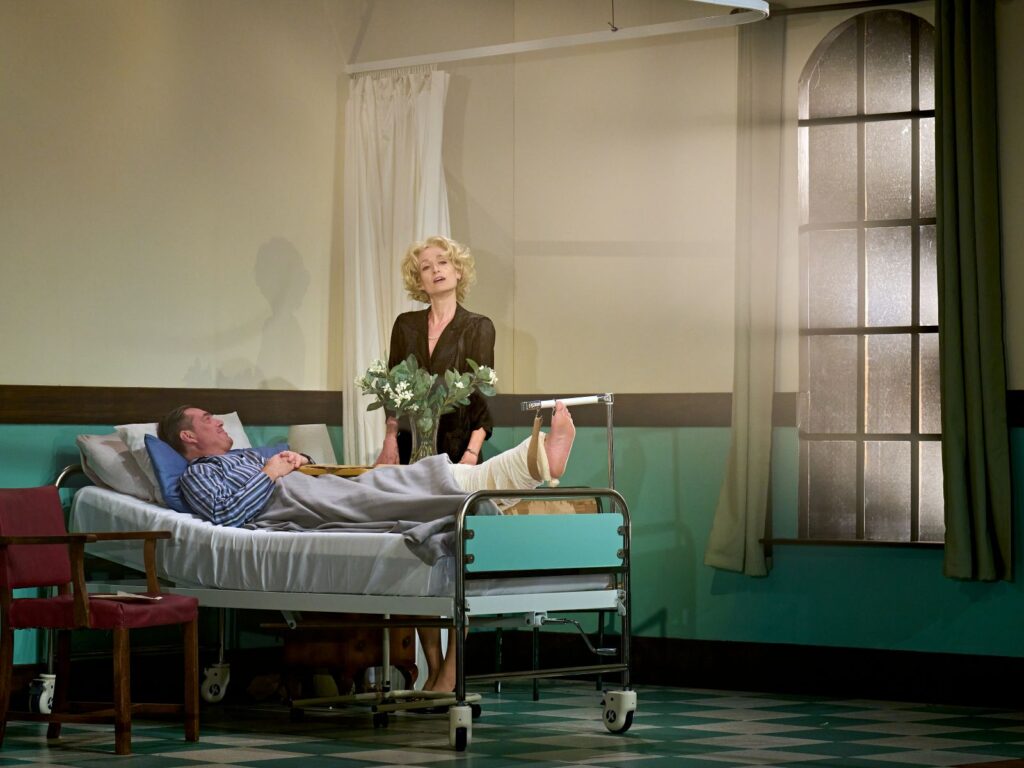
Based on Josephine Tey’s crime novel, the play centres on Inspector Alan Grant (Rob Pomfret), a brilliant but cantankerous Scotland Yard detective confined to a hospital bed and compelled to turn his investigative skills to a centuries-old mystery.
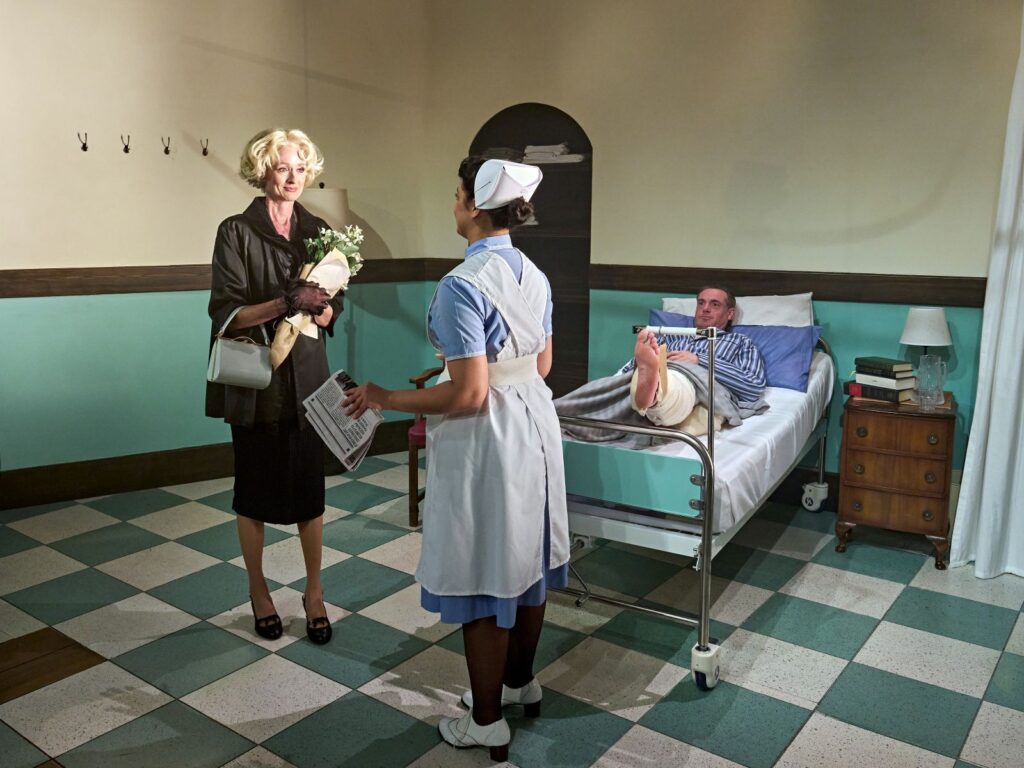
Set in London in 1950, Inspector Grant explores the alleged crimes of Richard III and the murder of the Princes in the Tower as a “cold case file.”
But what begins as a distraction becomes an urgent mission, as Grant tangles with two scheming Shakespearean actors, a couple of opinionated nurses, his own sceptical deputy, and a lovesick young American historical researcher to solve his case. Along the way, he might just solve the mystery of his own heart.
Pickup plays Marta Hallard, a glamorous leading lady of the London stage whose affection for Grant runs deeper than friendship. Meanwhile, Nigel Templeton (Noah Huntley) is a polished Shakespearean actor and Marta’s loyal confidante.
Directed by Jenny Eastop and adapted by M Kilburg Reedy, the play is running until Saturday, September 13.
Pickup – who has been starring in HBO series The Gilded Age – only first read Tey’s novel when she heard about the play and “loved it.” “But I love the play even more,” she says, noting how it strays from the source material, particularly when it comes to her own character.
As Marta, “I’m interested in the history and the detective work that Alan Grant does. But my main story is trying to get him to propose to me really, or to realise that he is in love with me and that we’re meant to be together,” she explains. “That’s definitely not in the novel. Josephine Tey just hinted at hinted at Marta Hallard being the person Alan would fall in love with, if he ever were to fall in love with somebody, but she never lets it happen in any of the five novels in which they’re present.
“So that’s a departure. But it’s quite an important one. Especially for an information-heavy play, it’s nice to have romance. It’s always nice to have romance and a more human story.”
The information Pickup refers to relates to Grant’s investigation into Richard III, which is supported by characters such as young American researcher Brent Carradine (Harrison Sharpe), Nurse Ingham (Hafsa Abbasi), Nurse Darroll (Janna Fox) and Sergeant Williams (Sanya Adegbola).

For the most part, the action on stage takes place in a hospital room. But at times, a red curtain is pulled across so Nigel can play scenes as Richard III as if he’s at the Old Vic Theatre. Another part of the set opens up to look as if it’s part of The Ivy restaurant, a famous theatrical dining haunt.
Getting into character to play an actor, Pickup jokes that it’s actually quite difficult in some ways, as audience members might have certain ideas about who Marta is and how she behaves.
“I certainly don’t want to make an actress a stereotype because that goes against so many of my beliefs, but also at the same time she is dramatic. She is a camp. She is theatrical, however you want to interpret that word,” she says. “She’s oftentimes larger than life. She’s loud. She’s passionate. Obviously – I say obviously, but it’s not obvious – she is passionate and so you use parts of yourself like you always do with whichever role you’re playing. For me, I always just have to go from the script and start from where it’s written rather than from where I am.”
But after opening at Charing Cross Theatre in July, Pickup says the play and the performances have evolved over its run as the cast became more comfortable with the historical information they had to convey.
“Now we feel very solid in that, there are so many other details and nuances that are allowed to come through,” she says. “I do think that happens hopefully with any run. And with a good play and a good company, you listen to each other, you listen to what an audience has been telling you over the last month, things recalibrate and you find different moments rise and fall. I’m sure it will continue to change.”
That a play is never “static” or exactly the same from show to show is part of the “great joy” of doing theatre for Pickup. But while audience members might think two performances were quite similar, the actors can pick out the tiny nuances that make each one feel very different for the cast.
“As long as you’ve got your basic sense of who you are and the story that you’re telling, as long as that’s absolutely solid, then you can feel free to move around on top of that and discover new things nightly – and hopefully even during a night. That’s the exciting thing about theatre,” she says.
Actors never want to repeat successful moments, however. “That’s death,” Pickup states. “When you start thinking to yourself that you did something good last night and want to do that same good thing again, that’s a sure way to kill it. If you do that then you’re trying to repeat an effect, and you never want to act an effect, because that’s not being a human being. You want to carry on acting a moment and an action. You want to be able to speak to another person, like a person, not because you’re trying to get a reaction from an audience.”
But it’s easy to fall into that trap, especially when there are laughs. “It is really gratifying to get a laugh in the audience, so you certainly don’t want to lose that,” Pickup continues. “But there’s a famous saying in the theatre, ‘Don’t ask for the laugh. Ask for the cup of tea.’ If you find yourself losing a laugh, it’s probably because you’re asking for it instead of actually just asking the question.”
The challenge of The Daughter of Time, and any play, is to always offer something fresh with each performance. That’s also the thrill.
“It’s been a really wonderful company and what I really loved about this company is that everyone really cares about the work,” she says. “The industry has changed a lot since I started and so much of it now is to do with public profile, social media followings and things which to me are literally nothing to do with the work.
“What I’ve found particularly thrilling about this is there’s lots of young people in the company and every single one of them is really interested in the work, in the text, in rehearsals, in the relationships – all of those fundamental things that sometimes are in danger of being lost these days with the emphasis that there is on your own profile, which seems to me to be not at all what acting is about or what theatre is about. That has been a real joy on this for me and very unexpected.”
As the show continues, Pickup has found it “quite surprising” how involved audiences have become in Grant’s historical investigation. “That has been really wonderful,” she says.
They’ve also enjoyed the personal relationships, not least the blossoming romance between Grant and Marta. “It’s very heartening to see people touched by a bit of old-fashioned romance,” she adds.
The Daughter of Time plays Charing Cross Theatre until Saturday, September 13. Tickets here.
Top image: Rob Pomfret and Rachel Pickup in The Daughter of Time. Credit Manuel Harlan (image supplied)